Why Do Tactical Patterns Matter for Junior Players?
Scholastic chess games rarely hinge on deep positional strategy. A junior might follow opening rules perfectly for the first several moves. They play 1.e4 e5 2.Nf3 Nc6 3.Bc4 Bc5 and demonstrate a clear understanding of piece development. The game unravels later. The result usually turns on an undefended queen, a trapped piece, or a sudden back-rank weakness.
When a move like Ng5 or Qh5 hits the board, it creates immediate threats. The student must check those threats, not guess at a response. Pattern recognition is the foundation skill that lets young players spot these opportunities quickly. Concrete wins motivate juniors far more than abstract positional ideas.
In a roughly 40- to 50-minute scholastic class, you can introduce one clean tactical motif, demonstrate it on a couple of boards, and practice it through a small set of positions without overloading younger players. Recorded results show that pattern recognition should be measured by response quality first. Can the player name the target, identify the forcing move, and explain the opponent’s reply?
How Were These 10 Patterns Chosen?
We sorted tactics through a few strict coaching filters. The pattern must appear naturally in beginner games. A child must be able to describe it in a brief sentence. Finally, the tactic must serve as a building block for more advanced combinations later.
The practical selection test is firm. If a motif requires more than about a dozen occupied squares to demonstrate using kings, queens, rooks, bishops, knights, and pawns, it usually fails in an introductory lesson. We prioritize patterns that exploit common scholastic errors: loose pieces, uncastled kings, trapped back ranks, and automatic recaptures.
The first pass belongs in a short multi-session block. You spend one session on forks and pins, one on skewers and discovered attacks, and one on mates and defender removal, followed by a dedicated review session.
The 10 Tactical Patterns Every Junior Should Master
Every tactic requires the same coaching rhythm. Name the pattern, show the forcing move, ask what the opponent is required to answer, and then let the junior solve a near-copy position.
1. The Fork
One piece attacks two or more targets. Picture a White knight on e5 jumping to c6+, attacking the black king on e7 and rook on a7. The verbal cue is "one move, two targets." The knight fork is the classic junior weapon.
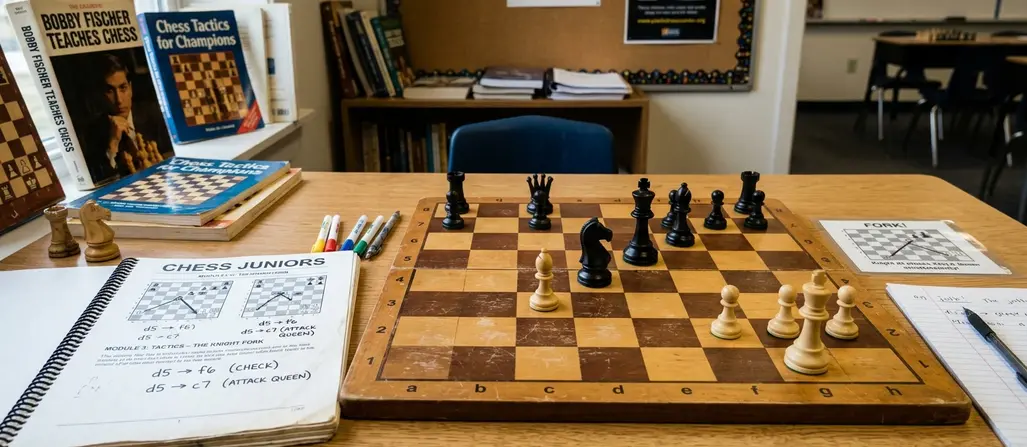
2. The Pin
This involves immobilizing a piece against a more valuable one behind it. A Black bishop on g4 pins a white knight on f3 to the queen on d1. This is a relative pin. If the king sits behind the piece, call it an absolute pin.
Pro Tip: A junior may correctly name a pin but still blunder if they do not check whether the pinned piece is actually defended or whether the king has a legal escape square.
3. The Skewer
The skewer is the reverse of a pin. A White rook on e1 checks a black king on e8, with a black rook sitting behind it on e7. The valuable piece is in front. Once the king moves, the rook falls.
4. Discovered Attack
A White bishop on b5 lines up against a black queen on e8. Moving the knight from d4 reveals the bishop’s attack while creating a second threat.
5. Double Check
A White knight moves from f7 to h6++, opening a bishop line on c4 while the knight also checks. The only legal response is a king move.
How Should Juniors Practice These Patterns?
Senior Master and author Robert M. Snyder emphasizes that practice must move from single-pattern recognition to mixed review. Start with blocked sets where every answer is the exact same motif. The child is learning the shape. Then mix two motifs, then four.
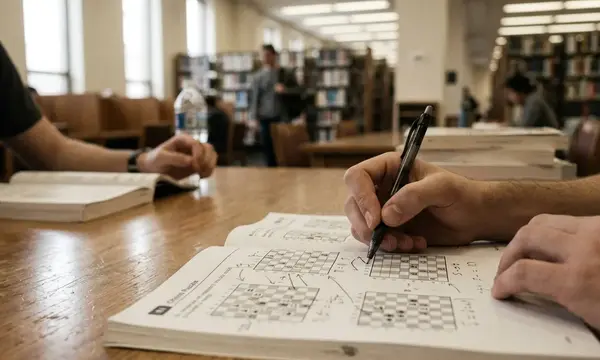
For home practice, assign about 8 to 12 puzzles in a sitting for younger juniors, and roughly 12 to 18 for older or tournament-active juniors. A useful weekly rhythm is several short sessions of about 10 to 15 minutes rather than one long worksheet session.
In camp settings, a tactics block breaks down cleanly:
- brief demonstration
- guided solving
- timed pattern recognition
- review
When reviewing a student game, mark only a few moments. Find one missed tactic for the student, one tactic the opponent missed, and one quiet move that prevented a tactic.
Warning: Timed puzzle races can reward guessing. Require the student to say the target and the forcing reply out loud before awarding credit.
What These Patterns Won't Teach (and What Comes Next)
Tactics alone do not win games — they are the fastest way for juniors to win material, but they do not replace opening habits or endgame technique. Ages and reading levels vary, so adapt the pacing to the individual child. A young player in a first club season may need one motif repeated across several boards. A middle-school tournament player can handle mixed sets and delayed tactics in the same lesson.
For very young players, replace written worksheets with board-based prompts. Ask them to "Find every check," "Find every capture," and "Find every threat."
After mastering the first set of motifs, the natural follow-up sequence includes two-move combinations, forcing-move calculation, basic king-and-pawn endings, and simple rook endings. A junior who solves single-motif puzzles quickly should next calculate candidate moves for a few ply before touching the piece.
While these patterns are a reliable starting toolkit for beginner and early-intermediate juniors, advanced tournament players need calculation training, defensive resource finding, and positional decision-making layered on top. Coaches looking for structured progression can consult the official US Chess scholastic resources to build out the next phase of their curriculum.