Why Do Junior Players Struggle to See Tactics?
A junior memorizes an opening line several moves deep but still hangs a queen because the knight fork pattern was never labeled and reviewed from the student's own games. Tactical blindness happens when players calculate move-by-move instead of recognizing recurring shapes—a habit that turns every position into an exhausting math problem.
The coaching diagnosis starts from the student's own moves.
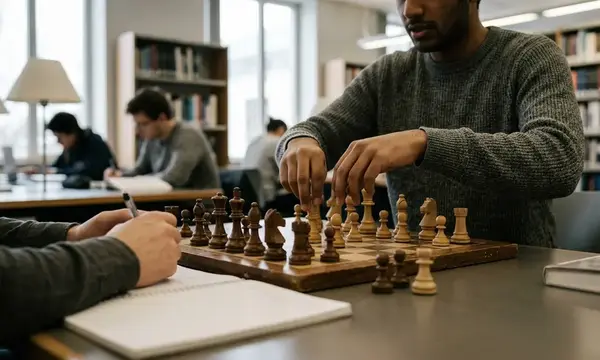
We look for moments where the student calculated one line but missed a basic shape. Common first-cycle motifs are pins, forks, skewers, discovered attacks, overloaded defenders, and back-rank mate patterns. In scholastic review sessions, the critical tactical miss often appears after normal development has begun. Coaches usually review the position after pieces have started contacting the center and kingside.
A useful review question is concrete: "What changed after the last move?" rather than "What is the best move?" This forces the student to notice newly opened lines and newly undefended pieces, converting random calculation into instant recognition.
What Is the Pattern-Recognition Principle in Chess Learning?
The method treats tactics as a recognition problem first and a calculation problem second. The instructor repeatedly shows the same motif in slightly different board settings until the student stops searching for the idea and simply sees it.
Repeated exposure to motifs builds a mental library the student retrieves automatically. Robert M. Snyder, a Senior Master and author, formalized this instructional emphasis in books such as Chess For Juniors from 1991 and Unbeatable Chess Lessons For Juniors from 2003.
The mental-library sequence follows a strict order.
- Identify the motif.
- Find the forcing move.
- Calculate the opponent's legal replies.
- Compare the final position to the original tactical target.
This approach fits scholastic teaching well. Juniors can recognize repeated visual arrangements before they can reliably verbalize long strategic plans. It prioritizes chunking and recall over brute-force calculation.
Why Start Beginners With the Open Games (1.e4 e5)?
Coaches choose openings for training yield, not fashion. We steer beginners into the double king-pawn structure after 1.e4 e5 because open files, diagonals, and early piece contact create repeated chances to see pins on knights and attacks on uncastled kings.
Early teaching positions often arise after natural developing moves such as Nf3, Nc6, Bc4, Bc5, and castling. These moves expose diagonals toward f7 and f2 while opening central lines.
The practical sequence introduces open lines first. We move to semi-open and closed structures only after the student can identify basic pins, forks, skewers, and back-rank themes without prompting. The protocol introduces motifs in positions where they recur naturally rather than relying entirely on abstract puzzles.
How Does the Game-Analysis Method Reinforce Patterns?
Raw puzzle volume does not reliably transfer when the student solves diagrams in isolation but never reviews tournament games where the same motif was missed under time pressure. Game analysis converts a played game into a labeled pattern file.
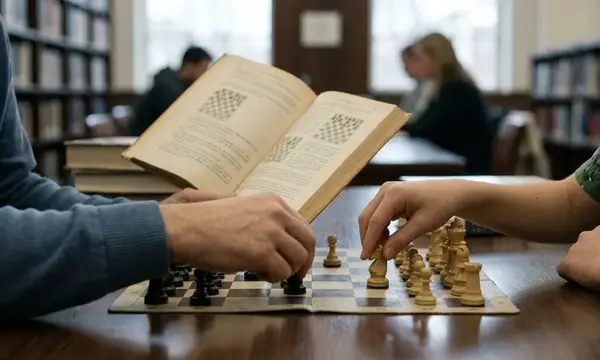
The student records the game, brings the score to the instructor, and the instructor replays it move by move. At each tactical turn, the coach flags the missed motif. The minimum artifact is a complete move record in algebraic or coordinate notation, plus the result and color played. The official U.S. Chess Federation rules of chess frame tournament scorekeeping, making notation a core part of the training process rather than a clerical extra.
A practical review pass has three marks: the first clear tactical chance, the move where the student lost the thread, and the corrected motif name. Recorded review can include board video with voice explanation so the student can revisit the same missed pin, fork, or mating net before the next lesson.
Pro Tip: Require a game record for review; without the moves, the coach can only discuss impressions instead of exact missed patterns.
What Tools and Setup Does Online Pattern Instruction Require?
For online instruction, board synchronization drives the entire setup decision. An online lesson can succeed on many modern platforms, but only if the teacher and student share a synchronized board and can replay variations without confusion.
Historically, the Internet Chess Club served as the primary software platform for these lessons. The older hardware recommendation was a cable-modem connection because it avoided tying up a second telephone line during an online session. Today, the board-sharing requirement remains operationally more important than the brand of platform. Both sides must be able to replay moves, reset positions, and analyze variations from the same diagram.
Required lesson setup includes a platform account, a shared interfacing board, a stable internet connection, voice or text communication, and a recording or note-taking method.
How Are Lessons Scheduled and Maintained?
We treat scheduling as part of instruction because pattern retention weakens when lessons are irregular. A weekly slot gives the student a predictable loop: play games, record them, review them, recognize the missed patterns, and play again.
Chess For Juniors operates as a membership organization providing this structured instruction. Under the program policy, guaranteed weekly lesson times require 21 days' written notice for schedule changes. An account remains active with a minimum of one session per year.
Private lessons sit alongside camps, tournaments, and training-center work. The weekly lesson serves as the main rhythm for reinforcing recognition.
Who Has Learned Through This Method?
Instructors have applied this method beyond the usual scholastic classroom by adapting the same pattern-review loop to busy adult learners. The process remains identical: identify the student's games or practice positions, mark recurring tactical shapes, and review the corrections.
From widely cited sources, actor Will Smith began chess lessons in March 1998 during the filming of Enemy of the State. Weston Cage began lessons in October 1999, with Nicolas Cage connected as the client. Jeremy Cone, creator of the 'So You Want to Play Chess' website, belongs to the broader instructional community around junior chess learning.
These documented examples show the method applied to learners outside the typical scholastic age, providing context for how the framework scales.
What Are the Limits of the Pattern-Recognition Approach?
The framework is strongest when a student repeatedly sees tactical shapes, but the coach still has to add endgames, planning, time management, and tournament habits. Pattern recognition accelerates tactical seeing, but it cannot replace structured endgame study, strategic planning, or consistent coached review.
The method must be paired with endgame basics such as king-and-pawn opposition, simple rook activity, and checkmate technique. Based on student progress reviewed over multiple tournament cycles, no fixed improvement timeline should be promised. Progress depends heavily on game volume, review quality, attention during lessons, and whether the student practices the corrected motif afterward.
Older setup details such as cable modems and avoiding a second telephone line translate today into modern requirements: stable broadband, reliable board sharing, and a way to save the lesson record.
Warning: Pattern work tells the junior what to look for, but results depend on consistent practice and player engagement.
Implementation Takeaways for Coaches and Parents
The practical rollout is straightforward. Choose openings that produce tactics, make every serious game reviewable, and keep the same weekly learning cadence.
Start with Open Games after 1.e4 e5 so pins, forks, discovered attacks, and back-rank ideas appear early and often. Use a shared board for remote lessons so instructor and student analyze the same position, variation, and correction line. Keep a recurring weekly slot when possible, then use camps, tournaments, or training-center sessions as reinforcement rather than replacements for review.
Key Takeaway: The coach should resist the urge to overload the student with abstract strategy before basic tactical shapes are mastered.