Why Junior Players Struggle to Improve Past a Certain Point
Walk through a typical scholastic tournament hall. You will see a familiar plateau.
A junior reaches around move 20 in a standard short game. They have developed their pieces, castled safely, and navigated the opening. Yet, their clock is ticking down to single digits. They are spending immense mental energy scanning the board for simple one-move threats, re-evaluating every capture and check from scratch.
They know the rules. They can solve single-move tactics in isolation. But in a live game, they calculate move-by-move. A player might spot several legal checks in a position but completely miss that the opponent’s back rank has no escape square. They are counting individual moves instead of recognizing the mating shape.
This slow, effortful thinking drains their stamina, leading to blunders late in the game. The gap between knowing how pieces move and consistently noticing two-move threats during tournament play comes down to a lack of fast recognition.
What Is Pattern Recognition in Chess?
Pattern recognition is the ability to quickly identify familiar structures, tactics, and positions from memory. An experienced player does not look at a board and inspect isolated pieces. They see a known arrangement.
The board always has 64 squares, but strong players do not mentally process all of them equally on every move. They rely on chunks—groups of pieces stored in memory as a single meaningful unit. A castled king shielded by three pawns is one chunk. A rook dominating an open file is another. A bishop-queen battery aimed at h7 is processed as a single attacking concept rather than two separate pieces.
Consider a knight planted on e5. A novice calculates its reach square by square. An expert instantly sees a fork map attacking c6, f7, g4, and c4. They immediately recognize the back-rank motif when a king sits on g8 behind pawns on g7 and h7 with no flight square. They understand the pressure dynamics of isolated queen’s pawn positions at a glance.
This distinction between piece-by-piece calculation and whole-pattern recognition is well-documented in research on perception in chess. Novices build positions from the ground up. Experts retrieve them from a large mental library.
How Does Pattern Recognition Actually Develop?
Patterns build through repeated, deliberate exposure to recurring tactical and positional motifs. A coach introduces one clean motif, repeats it with small changes, and asks the student to explain why it works before mixing it into complex positions.
Understanding the underlying logic of a pattern always beats rote memorization. Robert M. Snyder, Senior Master and author, emphasizes that when a student grasps the forcing idea behind a tactic, that knowledge transfers to novel board states.
In scholastic instruction, a practical teaching sequence might keep forks in place for roughly 6 to 8 short sessions before introducing pins and skewers. Presenting every tactic type in a single lesson overwhelms the student. Spaced repetition cements these concepts into long-term memory. A coach might revisit a specific motif after a day, review it again a few days later, and bring it back about two weeks later using entirely new board positions.
For younger juniors, a useful set size is often around 8 to 12 themed positions in one sitting. The focus remains on discussing the forcing idea rather than simply marking the answer right or wrong.
How to Train Pattern Recognition in Young Players
Many instructors initially hand out random puzzle sheets because a mixed format feels closer to the chaos of a real game. I quickly dropped that approach for early learners. When faced with random tactics, beginners start guessing the tactic type instead of reading the board.
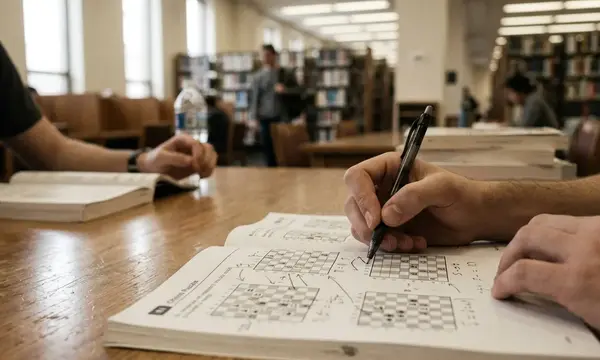
Themed drills provide a much stronger foundation. A structured week might feature a short set of fork positions on Monday, a similar set of pin positions on Wednesday, and a mixed review at the end of the week. This isolates the pattern before testing the student's ability to differentiate it.
Pro Tip: Short sessions are far more realistic for junior attention spans. Focused pattern work lasting roughly 10 to 20 minutes is usually more productive than a long puzzle block.
Annotated master games also expose students to recurring structures in their natural context. However, game study should stop at a few key positions rather than covering every single move. This is especially true for younger players who are still developing the vocabulary to verbalize long-term plans. During camp or tournament preparation, ask students to label the pattern after their own games. Having them identify a back-rank weakness around move 20 or a knight fork threat after the queen moved away reinforces the mental template.
What Pattern Recognition Cannot Do Alone
Recognition without calculation is dangerous. It often leads to pattern-matching errors in novel positions. A familiar shape triggers a reflex, and the player moves without verifying the specific details of the current board.
A classic failure case occurs when a junior recognizes a back-rank mate shape but plays the rook check too quickly, missing that the defender has a knight capture available because one key guarding piece is absent. Similarly, a student might spot a familiar bishop sacrifice on h7, completely overlooking that the defending king can safely step to g6 because the usual supporting knight on f5 is missing.
Patterns must be paired with strict verification. After recognizing a motif, the player needs a routine to check forcing replies. They should evaluate checks, captures, direct threats, and finally the opponent’s strongest escape square. To reduce cognitive load for younger juniors, ask for just one candidate move and one opponent reply before requiring them to build a full variation tree.
Warning: These recommendations reflect general scholastic coaching practice. Implementing them does not guarantee immediate rating gains. Actual tournament improvement relies heavily on playing frequency, feedback quality, emotional regulation, and over-the-board experience. Age and developmental readiness dictate the pacing. A young beginner may need the same fork pattern shown across several near-identical boards, while an older tournament player may benefit more from mixed tactical review under a clock.