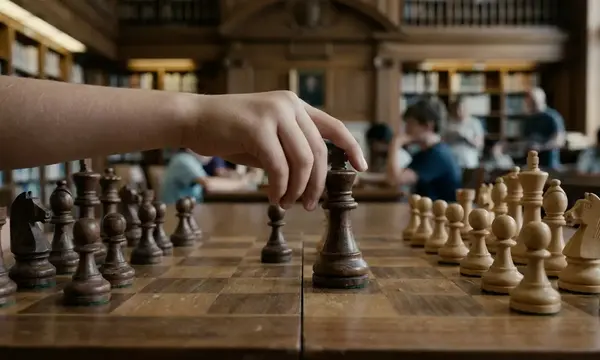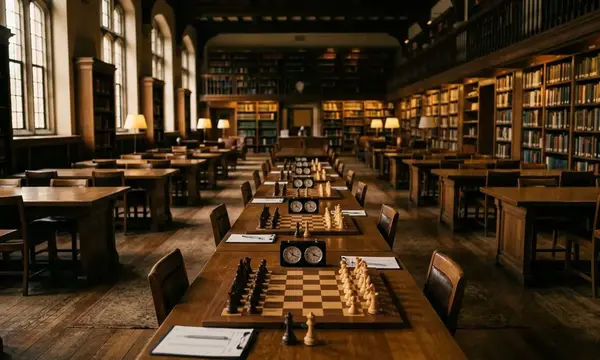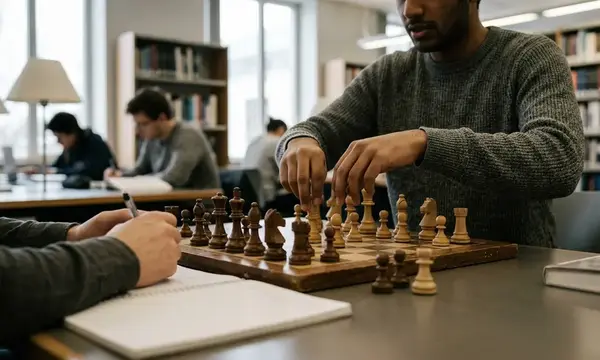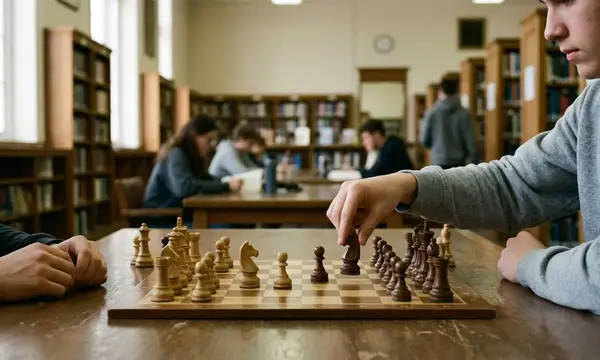
Why Do Young Chess Players Need Structured Resources?
Parents often bring a familiar problem to scholastic programs. A child plays legal moves, wins casual games against family members, and knows basic openings. Yet, they hit a wall.
In practice, a typical junior plateau surfaces when the student knows how to castle and deliver checkmate, but moves too quickly in positions filled with pins, forks, loose pieces, and exposed kings. Giving them an opening-heavy book before they can reliably identify these basic tactical motifs is a common failure case. The result is memorized move orders that collapse after the first unfamiliar reply.
A practical training sequence fixes this. We start with rules and notation, move to simple tactical motifs, introduce model games, and only then build a small opening repertoire. Pattern recognition acts as the bridge here. Juniors must see recurring board shapes before they can use memorized opening moves correctly.
How Did We Choose These Resources?
Evaluating scholastic materials requires asking a blunt question: can a coach use this in a real junior lesson without translating adult assumptions every few pages? The screening emphasized whether a book can move a child from basic rules, such as en passant, into named systems like the Ruy Lopez, Sicilian Defense, Vienna Game, and Nimzo-Indian without skipping the explanation layer.
We focused on the series authored by Robert M. Snyder. His Senior Master background matters because these books are not merely puzzle collections. They are built around lesson order, model games, and competitive preparation. Resources earned their place when they included full-game analysis or repeated tactical themes rather than isolated diagrams with no follow-up discussion.
Keep in mind this is a curated path through one instructor's junior-oriented series, not a complete survey of every worthwhile chess book for children.
1. Chess For Juniors (1991): The Foundation Text
This title belongs at the start of a training path because it does the work a foundation text should do. It slows down at the rules and notation stage before asking a junior to care about named openings. The 1991 volume covers core rules, including en passant, and introduces English Descriptive notation rather than assuming modern algebraic fluency.
The opening coverage reaches beyond beginner traps. It introduces the Ruy Lopez, Sicilian Defense, and Nimzo-Indian as recognizable systems. Paul Morphy game analysis gives beginners a concrete attacking model. Students see rapid development, open lines, king safety, and the immediate punishment of delayed development.
2. The Chess For Juniors Instructional Video (1991)
Young beginners do not all learn well from static diagrams. For a child who confuses diagonal movement, castling direction, or how an attack unfolds across several moves, seeing the pieces physically shift makes a difference.
The companion instructional release was produced in 1991 in VHS format. Its modern value lies in instructional design rather than convenience of playback. It features an on-screen introduction by actor Bill Windom, placing it firmly in the early-1990s scholastic teaching style.
Its strongest use case is the absolute first stage of instruction. Coaches can use it to demonstrate piece movement, board orientation, simple threats, and basic strategic language before asking a child to replay master games independently.
3. Unbeatable Chess Lessons for Juniors (2003)
We treat this book as the immediate step after the foundation text. Because it is organized as lessons rather than as a reference manual, a coach can assign a defined unit, review the core concept, and test the student's understanding.
The 2003 program opens with the Vienna Game across lessons 1, 2, and 3. This gives juniors repeated exposure to one opening structure before expanding the menu. Later, lesson 12 covers the Breyer Variation of the Ruy Lopez, making it suitable after a student already understands basic development and central tension.
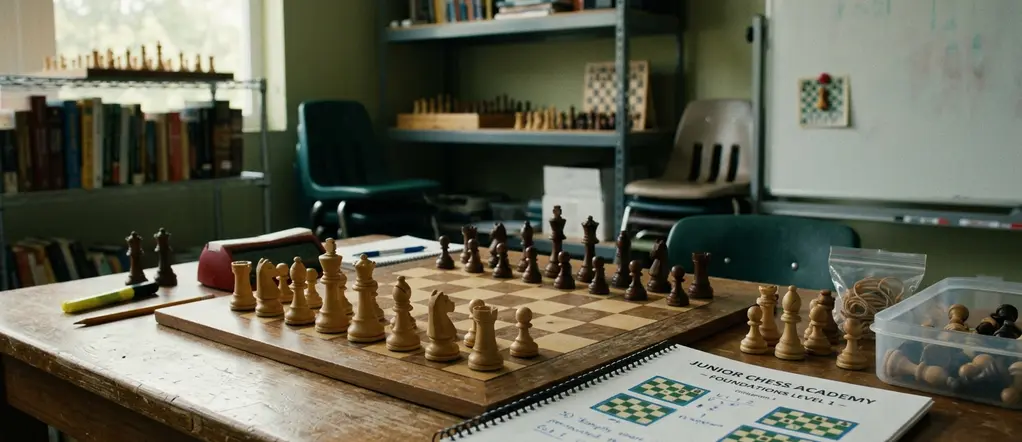
Tactics and history blend well here. Lesson 18 teaches the smothered mate and the Arabian mate. These named mating patterns are easier to retain when students physically replay the final net. Bobby Fischer's games appear in lessons 11, 16, and 17, featuring material connected to the 1972 title match against Boris Spassky.
4. The 2005 Opening Theory Volume
Young players often misuse opening study as mere move memorization. This volume belongs after tactics and model-game work, when a junior can finally ask what a move is trying to achieve.
The 2005 opening-focused volume analyzes the King's Gambit, Petrov's Defense, and the Leningrad Nimzo-Indian. It provides White and Black repertoire material rather than a single-system approach. The Snyder Sicilian is introduced with the move order 1 e4 c5 2 b3, giving juniors a concrete anti-mainline Sicilian structure to examine.
It also covers the Desperado tactical concept. Opening preparation often leads directly into middlegame positions where a doomed piece can still create forcing play.
Pro Tip: A realistic assignment is one opening chapter over a 7-to-10-day practice window, followed by two over-the-board training games using that exact structure.
5. The Tournament Guide (2004): Competing With Confidence
Tournament readiness is entirely different from chess knowledge. A junior can know tactics and still be unsettled by pairings, clocks, ratings, and tournament hall noise.
The 2004 tournament guide profiles young champion Cory Evans, using competition context rather than abstract advice alone. It explains the Swiss System pairing format, which many scholastic players encounter when they enter a multi-round rated section. It also breaks down the USCF Rating System so juniors understand why a first rating may move sharply and why a single event does not define their chess strength.
The strongest time to use this guide is during the 3-to-5-week preparation period before a first rated or scholastic tournament. During this window, a coach can still rehearse scorekeeping, clock use, and post-game review.
How Should Coaches and Parents Use These Together?
The recommended order follows how juniors usually absorb chess in lessons. A workable coaching sequence is the foundation text, then tactical lessons, then the 2005 opening volume, and finally the tournament guide before the child's first rated event.
Context-dependent variation matters. A school club meeting once per week needs shorter assignments and more board repetition. For weekly clubs, one Snyder lesson can be assigned across a 45-to-60-minute meeting. The first part is used for board demonstration and the second part for student replay. A tournament-prep student can handle deeper game analysis, notation conversion, and timed practice games.
Featured master games should be replayed on a physical board at least once before a child is asked to explain the plan verbally. Tournament preparation should happen before the event, not afterward, because pairings, clocks, notation, and nerves are all easier to manage when rehearsed in advance—long before the first clock is pressed.
Warning: Older material may use English Descriptive notation, while most current scholastic play, databases, and online tools use algebraic notation. The print volumes predate today's engine analysis, puzzle apps, and online game review tools. A complete training plan should still include live feedback, slow over-the-board games, post-game analysis, and supervised practice against peers.