
What Is a Scholastic Tournament, and Why Does the First One Feel Different?
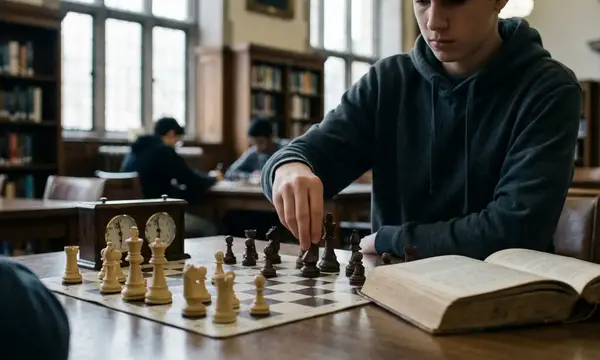
A scholastic tournament is a structured, rated competition for junior players—complete with posted pairings, assigned boards, timed games, and round-by-round results. Most first-timers are not confused by legal moves. They are thrown by the sequence of check-in, pairings, clock start, scoresheet use, result reporting, and waiting between rounds.
Frame the first tournament as a school-day logistics problem before treating it as a chess problem. The junior needs to know where to sit, when to stop talking, how to report a result, and what happens next. The program context includes junior events tied to national scholastic circuits and all-ages scholastic championship pathways, without assuming every local event follows the exact same operating routine.
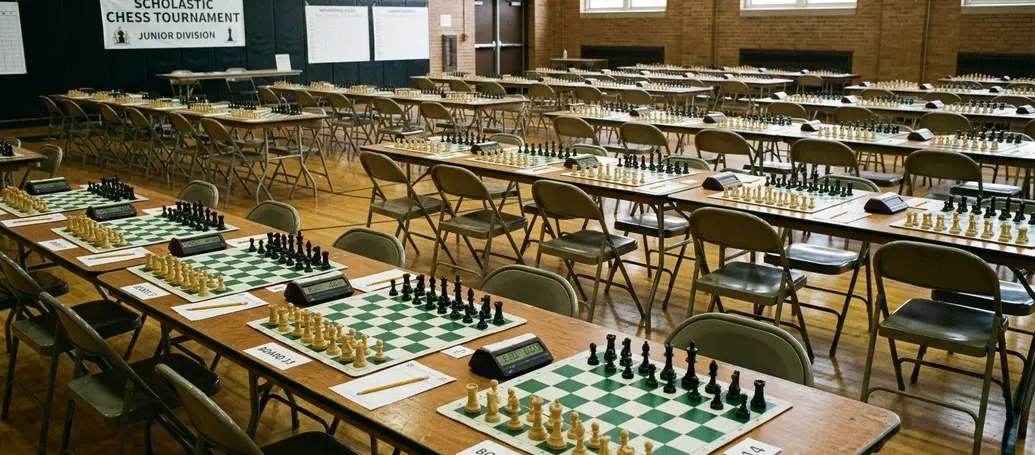
Preparation is logistical and emotional, not only tactical. When a child understands the playing hall, they can focus their mental energy on the board.
How Do Swiss Pairings, Rounds, and Time Controls Actually Work?
Explain the day from the child's seat, not from the organizer's desk. First, they find their name on a pairing sheet, then a board number, then a color, then an opponent. Once that order is understood, the rest of the day follows a predictable rhythm.
In a 4-round Swiss event, players are not eliminated after a loss. After each round, they are normally paired with another player on a similar score. A typical score path might be 1-0 after round 1, 1-1 after round 2, 2-1 after round 3, and 2-2 after round 4. The child still plays all scheduled rounds unless withdrawn.
Sudden death time control means each player receives one fixed block of time for the entire game. If a player's clock reaches zero before the game ends, that player loses if the opponent has sufficient mating material. A practical event rhythm is to arrive 30 to 45 minutes before round 1, check pairings 5 to 10 minutes before each round, play, report the result immediately, then reset with food, bathroom, and quiet time before the next posting.
Warning: A junior who knows a strong opening trap can still lose because they forget to press the clock, stop recording moves, or do not know how to report the result.
What Are USCF Ratings and IDs, and Does Your Junior Need One?
Treat the rating conversation as identification first and ranking second. Parents usually want to know whether their child is ready to compete. The operational answer is that the permanent player ID matters most. A national chess federation ID functions like a permanent player record. It follows the junior from event to event and keeps rated results attached to the same person.
Unrated players can enter many beginner scholastic sections. After their first rated games, their rating is usually provisional until enough games are recorded. The United States Chess Federation (USCF) rating system serves as the standard skill metric across these events.
Parents should verify the spelling of the junior's full name, birth date, state, and ID before submitting an entry. Duplicate records are harder to fix after results are rated. Some scholastic events have also used online chess-server formats, where tournament details may be retrieved through a command-style lookup such as FINGER CFJ-TOURN.
How Do You Register and Hit the Early-Bird Deadline?
Use a registration sequence that prevents two common errors: entering the wrong section and missing the discounted deadline. Confirm the event date and section before paying. Age, grade, rating ceiling, and unrated eligibility can point the same child to different sections.
- Confirm the event date and section eligibility.
- Look up or obtain the player ID before completing entry so the organizer does not have to match the player manually later.
- Submit the entry and save the confirmation email or receipt in two places: the parent's phone and a printed copy or screenshot accessible without Wi-Fi.
The early-entry cutoff is often about 7 days before the tournament date. A Saturday event should be treated as having a registration decision point the previous Saturday, not the night before.
For online formats, confirm the child can log in from the playing device and can find tournament instructions before the first round. Do not leave command lookup practice for the morning of the event.
What Should Your Junior Practice in the Final Week?
The useful decision is to stop expanding the child's chess menu. A coach may try adding a new opening line early in the week, then drop it if the junior is still asking where the pieces go after move four. Use the final five to seven days for review, not reinvention. Focus on familiar opening setups, common tactics, basic endgames, and tournament habits.
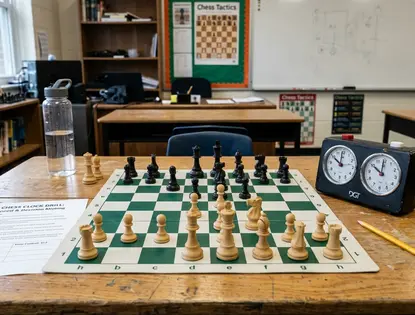
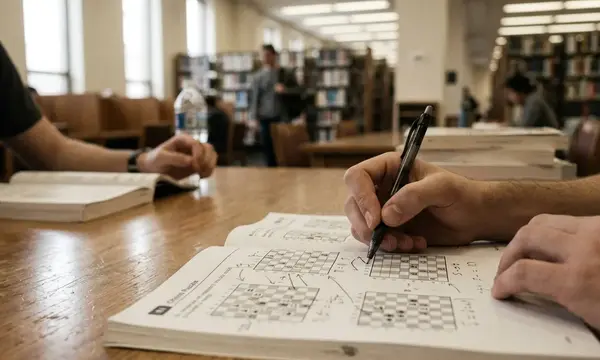
Tie instruction to pattern recognition, a method championed by Robert M. Snyder, Senior Master and author for iUniverse. Pins, forks, back-rank threats, hanging pieces, and simple mating nets should be recognized quickly rather than calculated from scratch every move.
Run two short clock drills where the junior must make legal moves, press the clock with the same hand, and notice when their time is low. Practice recording moves for at least one game segment of 12 to 20 moves so the scoresheet does not feel like a new assignment during round 1.
Rehearse three spoken scripts: "Good game," "I would like to ask the tournament director," and "I resign" or "checkmate" only when the child understands the position.
What Does Success Look Like (and What It Doesn't)?
Define success before the first pairing goes up. If the only goal is a trophy, the child can feel the day has failed by lunchtime. First-event success can mean playing all scheduled rounds, shaking hands, writing enough moves to review one game, asking an adult official instead of arguing, and eating or resting between rounds.
Strong junior programs have produced national-level champions through structured training. Recorded results show players such as Harutyan Akopyan, a 10-time national champion, and Asuka Nakamura, a 3-time national champion, developing through these pathways. Those championship references belong to a historical 2003 to 2005 program-results window and should be treated as context for what structured training can support, not as a prediction for a new player's first event.
A first rating or first placement is a starting measurement, not a verdict. It mainly tells the coach what to train next.
What to Verify Locally
Separate stable tournament habits from items that must be verified locally. Etiquette, clock awareness, and emotional readiness transfer well. Fees, section names, online procedures, and prize structures change.
Verify the current entry fee, section eligibility, time control, membership requirement, rating submission policy, and withdrawal procedure with the organizer before event week. Historical donor prizes such as Saitek Industries computers, Nate's Restaurant gift certificates, or named sponsor awards should be described as past examples, not standing offers. Older online command references and scholastic circuit labels may reflect a specific program era and should be checked against the current event announcement.
Pro Tip: The binding rules are always the current event announcement, the organizer's instructions, and the national federation's active rulebook.