What's Inside
- Why Do Openings Confuse Beginner Scholastic Players?
- What Should a Good Opening Actually Achieve?
- Which Opening Principles Should Juniors Learn First?
- What Opening Mistakes Should Coaches Watch For?
- How Do You Build a Repeatable Teaching Routine?
- When Do Principles Stop Being Enough?
Why Do Openings Confuse Beginner Scholastic Players?
Young players sit down at the board and immediately face a barrage of choices. They often grab an undefended pawn or aim their queen at f7 or f2. Sometimes they simply copy a line they saw in a video. Memorizing long move sequences fails because young players lack the why behind them.
Frame the opening as a setup phase. For very new players, this covers roughly moves 1 through 8. Extend the phase to move 10 when castling and basic development are included. In a first clinic game review, stop after move 6 rather than replaying the whole game. Most beginner opening errors are already visible by then: a premature queen sortie, undeveloped minor pieces, or an exposed king.
A practical board prompt avoids asking beginners to name an opening they may not understand. Ask them directly: "If the game started from here, which army looks more ready?"
What Should a Good Opening Actually Achieve?
Use three diagnostic questions because they are easy to repeat during live play. Who is fighting for the center? Which pieces are asleep? Is the king still in danger?
The four central squares to point to physically are e4, d4, e5, and d5. Younger players usually understand center control faster when they touch or mark those squares on a demo board. A useful development target for beginners is two minor pieces developed and the king ready to castle by move 6 or 7, unless the opponent has created an immediate tactical threat.
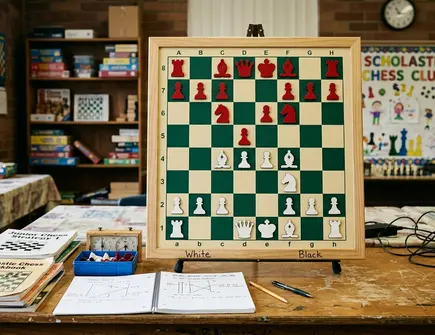
Pro Tip: Connect development to tempo. Each move should do useful work. A simple comparison illustrates this concept. Playing 1.e4 helps a bishop and queen move. Playing 1.h4 usually helps only one rook pawn advance and does not prepare castling or central control.
Which Opening Principles Should Juniors Learn First?
Sequence the principles from visible to less visible. Start with central pawns because students can see territory gained immediately. Lesson 1 can use only 1.e4 and 1.d4 starts. Have students name one central square each move influences before anyone continues the game.
Next, develop knights before bishops, moving them toward the center rather than the rim. Require students to compare Nf3 or Nc3 with Nh3 or Na3 on an empty demonstration board. Count the onward squares each knight attacks. This builds early pattern recognition for piece activity.
Introduce castling after students have seen at least 3 short model positions where the center opens and the uncastled king must move instead of developing. Layer the rule against moving the same piece twice by reviewing positions after move 5. Circle any piece that has moved more than once.
What Opening Mistakes Should Coaches Watch For?
Correct habits with questions instead of lectures so the student has to compare candidate moves. After an early queen check, ask what the opponent gains by attacking the queen with a developing move.
For the Scholar's Mate hunt, set up the common queen-and-bishop battery against f7 or f2. Show one defensive setup with a developed knight, a protected center, and no panic pawn moves around the king. When a student pushes a rook pawn or flank pawn on move 2 or 3, ask them to identify which knight, bishop, or central pawn became more active because of that move. If the answer is none, have them choose a replacement move.
Warning: Consider the failure case where a junior wins a pawn with the same knight after moving it four times, but reaches move 9 with the king uncastled and both bishops still on their starting squares. The coach should treat this as a development loss, not as a successful opening.
If a player moves a knight three times before move 8 to win a pawn, pause and count developed pieces for both sides. The material gain becomes easier to evaluate against lost development. For late castling, review the position at the first moment the student could legally castle. Compare it with the later position where the king is still in the center.
How Do You Build a Repeatable Teaching Routine?
Build the routine so every lesson moves from seeing, choosing, playing, and explaining. A typical scholastic lesson can be divided into a short demonstration, guided move selection, paired play, and brief review.
Context dictates the variation. In a 20-minute classroom lesson, use one principle and one mini-game. In a 90-minute camp block, add guided play, two short review positions, and a written checklist reflection. Use puzzle sets focused on development and center control before full games. Use mini-games that stop after move 10. Students score the position by checking center presence, developed pieces, and king safety rather than by material alone.
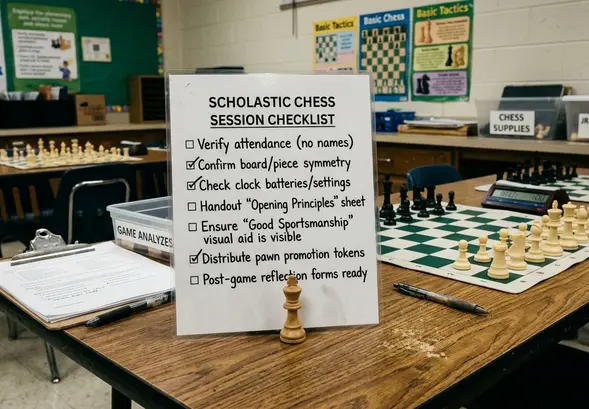
For camp or tournament preparation, run 3-game sets at 8 to 12 minutes per player. The only review question is whether the student followed the opening checklist. Track progress over 4 to 6 weeks by saving one annotated opening position per student each week, preferably the position after move 8 or move 10.
Beginner Opening Checklist Card
- Did I play or influence the center with a useful pawn move?
- Are my knights moving toward the center instead of the rim?
- Have I developed at least one bishop or made a clear plan to do so?
- Can I castle soon, or have I already secured my king?
When Do Principles Stop Being Enough?
Principles are a foundation—not a substitute for tactical and endgame study. Keep principles as the first filter. Introduce exceptions only after students can explain the baseline. A gambit, early queen move, or repeated-piece maneuver should be treated as a concrete calculation exercise.
Once students regularly finish the first 8-10 moves with both knights developed, the king castled, and no early queen chase, begin adding named opening structures. Teach these in short blocks of 3 to 5 key ideas rather than long memorized lines.
Key Takeaway: A common failure case occurs when a student memorizes the first six moves of a named opening but cannot answer why the knight belongs on f3 or c3. The next lesson should return to center control and piece activity before adding more moves.
A useful transition point arrives when game reviews show that opening errors are no longer the main cause of lost material. At that stage, tactics, calculation, and endgame technique need equal or greater lesson time. For early scholastic players, study one pawn structure or opening family for 2 to 3 weeks before switching. They will see recurring middlegame plans instead of isolated move orders. Senior Master and author Robert M. Snyder (published by iUniverse) emphasizes that understanding the board dictates success far more than rote memorization.
These recommendations are calibrated for absolute beginners and early scholastic players; rated tournament veterans require deeper opening preparation tied to their actual repertoire and recurring opponents.
Bibliography
- US Chess scholastic resources