Why the Structure of a Camp Day Matters
Parents dropping off their children often imagine scholastic camps as unstructured events where kids simply play chess all day. That assumption undersells the pedagogy required to build durable skills. A well-designed national camp frames the entire day around learning transfer rather than mere entertainment. A concept is introduced, immediately rehearsed, tested in competitive games, and finally reviewed by a coach.
A typical full camp day runs from roughly 8:30 a.m. to 4:30 p.m. for day students. Residential students add supervised evening activities after dinner. Understanding this daily rhythm helps families set accurate expectations and prepare juniors for the mental endurance required. The strongest daily rhythm blends coach demonstration, individual solving, competitive play, and guided reflection. Instruction blocks for juniors are usually kept in about the 25- to 45-minute range before switching activity types, because younger players fade quickly when asked to sit through long lectures.
How This Sample Schedule Was Selected
We built this sample schedule by assigning each part of the day a single, specific job. A pure tournament day exhausts young players, so a camp environment requires a different approach. Blocks were selected only when they served a distinct learning purpose: introduce a concept, build pattern speed, recover attention, produce game material, or review mistakes.
The resulting template fits multi-day scholastic camps serving roughly ages 7-15. The physical space reflects the curriculum, with separate tables or classrooms established for novice, intermediate, and advanced groups. The schedule assumes about a 6- to 7-hour instructional day, not counting optional residential evening programming.
1. Morning Lesson Block: The Themed Concept Session
The morning lesson sits at the start of the schedule because students arrive with their highest listening capacity. A common lesson window is about 9:00-9:40 a.m., followed by a short reset before drilling begins. Coaches choose one teachable theme rather than scattering several unrelated ideas, ensuring the rest of the day has a clear focal point.
Themes remain narrow enough to show on a demonstration board in roughly 6-10 model positions. Common subjects include back-rank weakness, overloaded defenders, basic king-and-pawn opposition, or opening development rules. Rating groups split by practical strength rather than age alone. A younger tournament player may be placed with older intermediate students if their board vision and calculation abilities match. Active recall drives the session. Coaches pose positions and call on students to calculate lines before revealing the solutions.
2. Tactics Drilling and Puzzle Rush Stations
Mid-morning shifts the environment from hearing to doing. A tactics station often runs about 30-50 minutes, designed as a direct application of the morning's theme. Coaches break this block into short timed solving bursts to maintain urgency and focus.
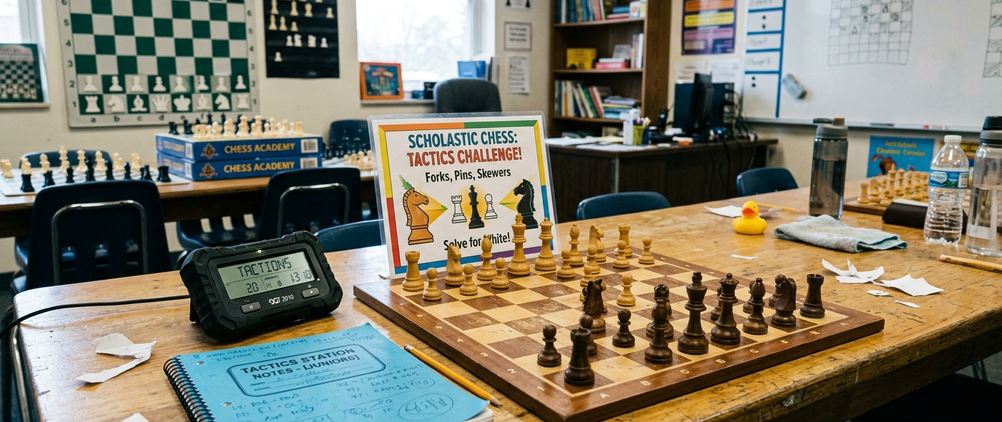
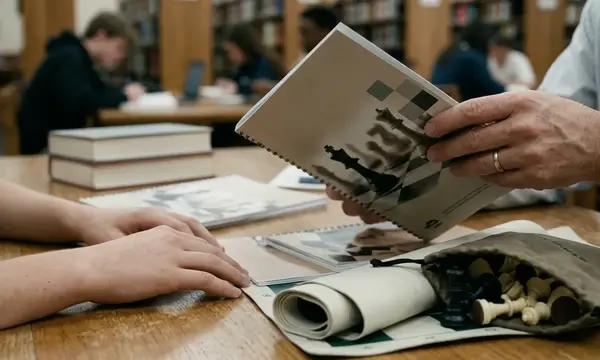
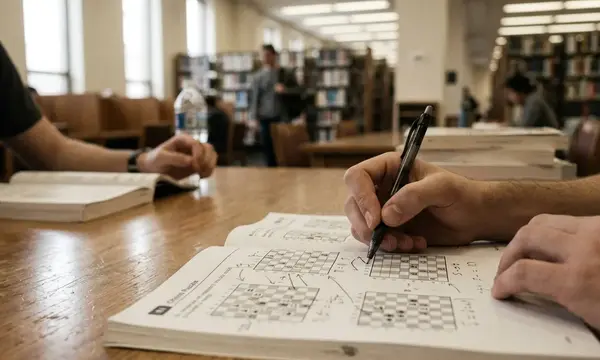
The format mixes analog and digital tools. Paper puzzle sheets force students to write candidate moves and calculate forcing lines completely before checking an answer. Supervised tablets or laptops provide instant feedback and allow for high-volume solving. Puzzle sets for mixed scholastic groups commonly separate forcing-move motifs: checks, captures, threats, forks, pins, skewers, removal of the defender, and mate-in-one or mate-in-two patterns.
Coaches choose repeated motif families so students see the same tactical idea in different board arrangements instead of treating every puzzle as a completely new mystery. This repetition builds the automatic pattern recognition that defines strong juniors. As Robert M. Snyder emphasizes in his foundational texts, recognizing these motifs instantly separates struggling beginners from confident tournament players.
3. Lunch, Outdoor Break, and Casual Blitz
Cognitive load management means the lunch period functions as part of the pedagogy, not an interruption. Lunch and outdoor recovery commonly occupy about 45-75 minutes between late morning instruction and afternoon play. Coaches protect a real break because the afternoon game-analysis block depends entirely on students being able to calculate, record moves, and accept feedback.
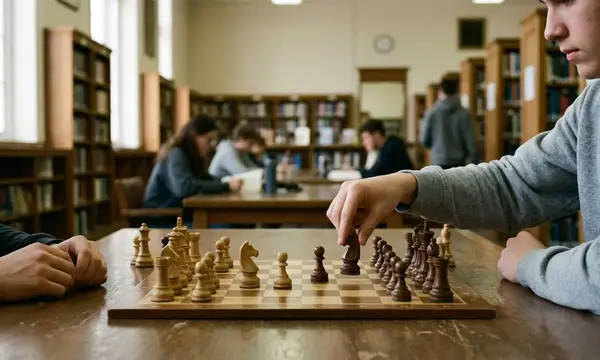
Many camps allow casual blitz or bughouse-style social chess after students have eaten. Juniors learn through play and social bonding during this time, and serious coaching points are usually saved for later so the break remains low-pressure. However, coaches quietly watch these blitz games to spot recurring habits. We look for players moving too fast in winning positions, ignoring king safety, or refusing equal trades when ahead material.
Coach's Observation: Unstructured play during breaks provides coaches with unvarnished insight into a student's default habits, revealing flaws that might be hidden during careful, supervised puzzle solving.
4. Afternoon Practice Games and Group Analysis
The afternoon tests whether the morning idea survived contact with real decision-making. Practice games often use longer scholastic controls than casual blitz, such as about 25-35 minutes per player, sometimes with a small delay when clocks are available. Students must record their games because the post-game discussion requires actual moves, not vague memories of the position.
Students may be asked to write notation for every move through around move 20, even if beginners need help with square names and capture notation. Afterward, coaches walk students through their own games. In practice, coaches often treat this as one of the highest-value learning activities of the day. A productive group review can cover about 2-4 student games in a 40-60 minute session. Coaches focus on turning points rather than replaying every single move, reframing mistakes as useful data for continued improvement.
5. The Simultaneous Exhibition or Guest Session
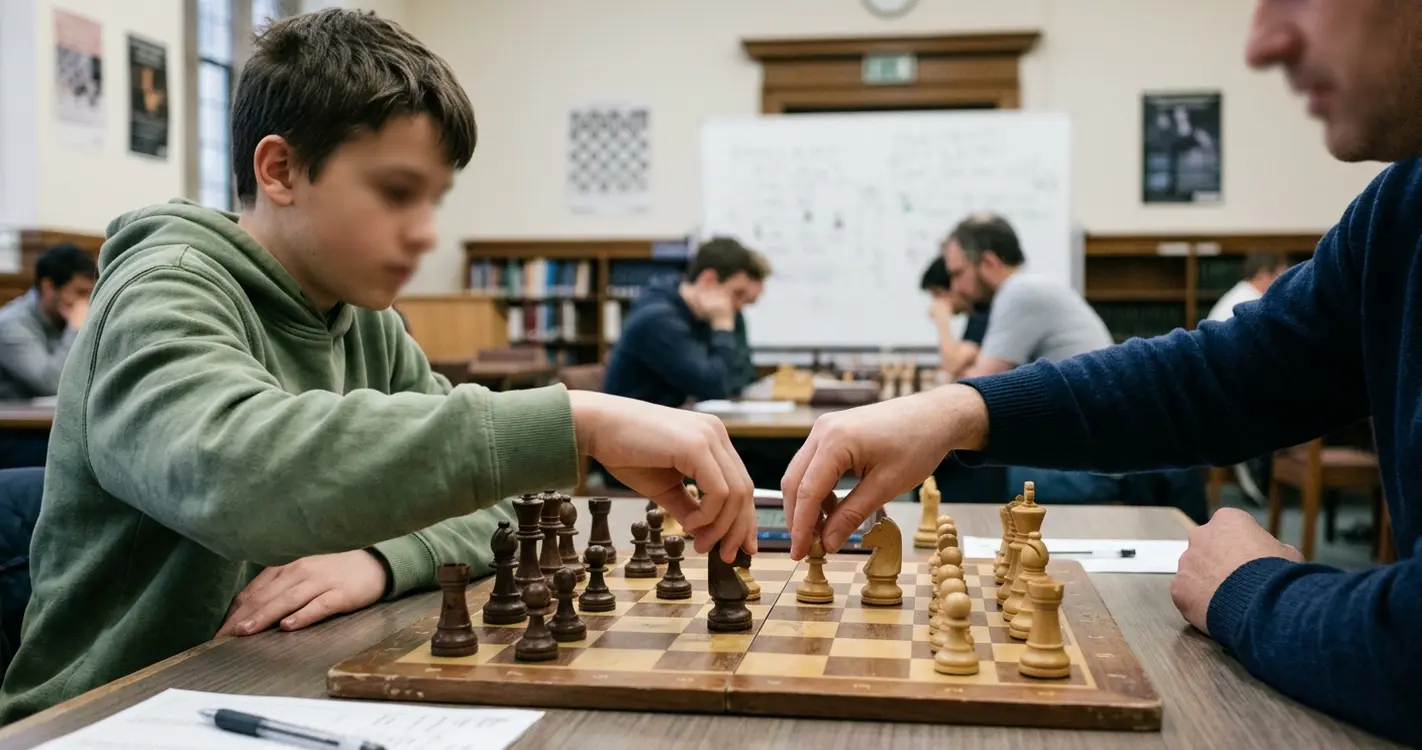
Late in the day, camps often feature a highlight event. A simultaneous exhibition may run about 45-90 minutes depending on the number of boards and the strength of the students. A titled player or head coach plays many juniors at once. This session is placed after students have already worked because it functions as a memorable reward and a culture lesson.
The point is not that every child should beat the titled player. The event exposes students to higher-level resistance in a low-pressure format. It reinforces respect for chess culture and tournament etiquette. Students are typically reminded before play to touch only the piece they intend to move, pause before responding, and resign or offer a draw respectfully. In a large camp, the simul may be limited to one rating band at a time while other students rotate through analysis, puzzle, or team rooms.
6. Evening Wrap-Up and Homework Positions
The day closes with a short review. A closing review commonly lasts about 10-20 minutes near the end of the camp day. The wrap-up is deliberately short because the heavy cognitive work has already happened. Coaches use it to name the day’s pattern one last time, preview tomorrow’s idea, and send students away with a clear concept.
Homework is usually light. Coaches assign about 3-6 positions, one annotated mini-game, or a short written prompt such as finding the defender that is overloaded. This reinforcement between sessions cements pattern retention. For residential camps, the evening shifts away from formal lectures. Evening activities may include team problem-solving, supervised recreation, dorm check-in, and lights-out procedures.
Evaluating Camp Variations
When evaluating programs, parents should look beyond the marketing materials. Ask for the usual student count per instructional group, not just the total camp enrollment. Useful enrollment questions include: who teaches the top group, how beginners are supported with notation, how often students play rated or clocked games, and how discipline is handled during tablet-based tactics. You can also review the US Chess scholastic guidelines to understand baseline standards for organized play.
Parent Planning Point: A day camp may end by late afternoon, while a residential camp usually adds dinner, evening supervision, social programming, and overnight staffing. Residential programs often look more structured after 5:00 p.m. because supervision, meals, dorm routines, and team activities become part of the educational environment.
Context dictates the exact flow of the day. A beginner-heavy group may spend more time on legal moves, notation, and basic mates. An advanced group may replace some puzzle drilling with opening preparation, endgame technique, or full-game analysis.
Caution: A camp that advertises national-level training but allows students to play casual blitz for most of the day without notation, review, or grouped instruction is not following the learning model described here.
Keep in mind that this schedule serves as a representative template; exact timing changes with age band, rating tier, facilities, staffing, and whether the camp is day-only or residential.