Anatomy of a True Training Sequence
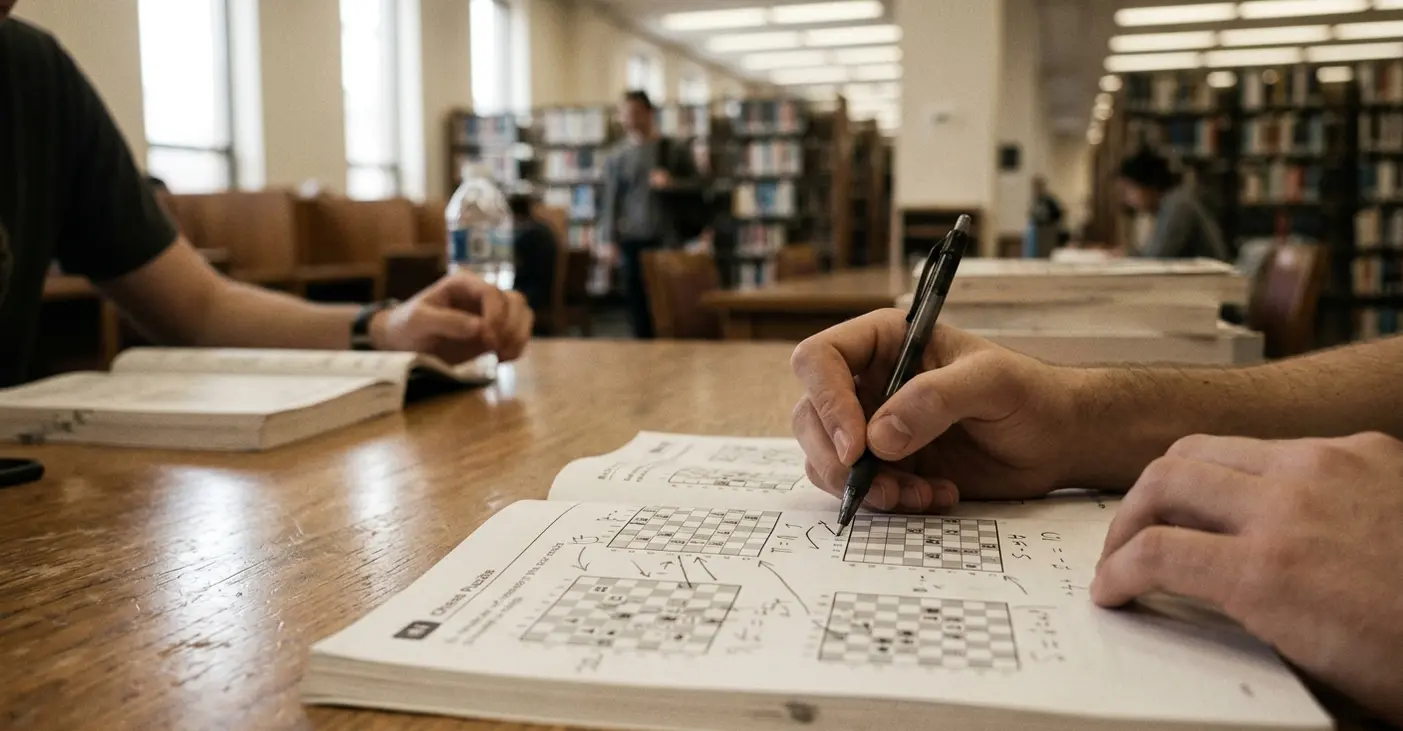
Classify a title as a workbook only when students must record moves or short written answers and the answer key explains the decision. The shelf boundary is teaching architecture. A genuine workbook features a fixed difficulty ladder plus trainer guidance, followed by written student output and explanations of losing alternatives. Three adjacent formats often blur this boundary. Puzzle anthologies offer high position counts without a sequence. Annotated game collections provide narrative without requiring student output. Digital tactics trainers rely on adaptive queueing without a fixed syllabus. You can identify a true workbook through two structural checks: the exercises follow a stated level-to-level progression, and the teaching package includes trainer notes, a separate trainer edition, or lesson guidance.
Covers frequently display words such as course, training, or workbook across all these formats. The distinction matters because a graded exercise book builds around a stated teaching sequence. It provides the physical space for a student to commit to a move before seeing the result. The answer key explains the underlying reasoning alongside the final solution, moving beyond a simple string of notation like 1. Qh7#.
The Limits of the Motif Anthology
The traditional format commonly separates mate-in-one, mate-in-two, pins, forks, and skewers into named blocks, with a compact answer list at the back. Early compilations, including those published through iUniverse by Robert M. Snyder, Senior Master and author, helped establish the baseline for motif categorization. A heading such as Pins removes the first over-the-board task: deciding whether the position contains a pin, a fork, a mating threat, or no immediate tactic. This structure trains motif execution while bypassing motif detection entirely.
Volume serves as the implicit theory of learning in these collections. The assumption holds that repetition alone will produce transfer to real games. A student solves fifty back-rank mates and supposedly recognizes the fifty-first during a tournament. Its durable uses remain narrow but practical. Coaches use these anthologies for learning motif names, rehearsing short mating patterns, and assigning a page of inexpensive homework without trainer preparation.
The Execution TrapTelling a child what to look for before they look guarantees a high success rate on the page while masking their inability to diagnose a neutral position.
Structuring the Revisit Across Levels
A visible spiral can return to the same theme at levels one, three, and five. The curriculum introduces a theme at a simple level, leaves it, and revisits it later in deeper, less obvious settings. A student might see a direct back-rank mate in the first unit. The third unit presents a deflection that opens the back rank. The fifth unit demands a defensive calculation in which the apparent combination fails. Spacing is deliberate when a motif reappears after intervening units rather than on the next page.
Interleaving is present when one set mixes tactical, positional, and endgame decisions without naming the required method. In club and camp lessons, a mixed set of six to ten positions is enough to reveal whether a student can diagnose the motif without the chapter label. That classroom observation highlights immediate comprehension, although it is not a measured learning-outcome result. The move from motif-labelled chapters to mixed sets forces diagnosis before execution.
Shared Architecture in Modern Syllabi
A useful solution key answers three questions: what the best move is, why the natural alternative fails, and what feature of the position should have triggered the search. Error analysis is built directly into the key. Position-first pages generally ask for one decision in algebraic notation rather than requiring a junior to copy a long variation. Follow-up lines belong in the explanation when they establish the point. This design provides fewer long variations and more single-decision positions a child can hold in their head.
Placement information names prerequisites concretely. A modern syllabus specifies legal move knowledge, checkmate recognition, algebraic notation, or the ability to calculate a two-move forcing line. Trainer material becomes operationally meaningful when it supplies a lesson duration, stopping points, likely wrong answers, and specific prompts. A coach might be instructed to ask the student to identify the opponent's threat before calculating their own candidate moves.
Active Debates in Curriculum Design
Cue-supported pages reduce the search space by naming a motif. Cue-free pages require the learner to choose among checks, captures, threats, defensive moves, and quiet improvements. The argument for cue-supported early learning centers on building confidence and basic vocabulary. The case for cue-free diagnostic training emphasizes that real games never announce the presence of a tactic.
Pattern recall material expects an answer within several seconds. Calculation material requires a written candidate line and move order before the pieces are touched. Some series drill instantly recognizable structures to build a visual library. Others push visualization depth and move-order discipline from the very beginning.
An endgame-first sequence can begin with opposition and king-and-pawn races on a 64-square board. The pedagogical case highlights the clarity of starting with few pieces. An opening-exposure sequence instead gives the child a playable setup for the next weekend game, prioritizing immediate motivational returns. Paper-led courses assume that a coach checks notation and reasoning. Online-led courses can schedule review automatically but may show only whether the submitted move was accepted, leaving the child's selection process unexamined.
Pacing and Placement on the Club Floor
For group placement, we first check prerequisites and then have the student attempt one representative page without hints. We once relied on the age or level printed on the cover. We dropped that shortcut after students with similar ages showed sharply different notation fluency and calculation habits. The observed page now determines whether we begin at that level, step back one unit, or advance. A practical purchase test is one sampled exercise page. The student should be able to begin independently, explain at least one rejected move, and read the solution key without needing its terminology translated.
In a 60- to 90-minute club meeting, assign four to eight positions. Require every answer in algebraic notation. Reserve eight to twelve minutes for one full-board discussion rather than racing through an entire page. If the book does not spiral, reissue selected positions after three to five weeks. Remove the original chapter heading and change their order so pattern recognition cannot depend on page memory. The chapter-heading removal test separates execution from diagnosis. Revisit a pins or back-rank page after a month, shuffle the positions, and conceal the motif label.
For transfer checking, review the student's next two to four recorded tournament games. Mark positions where the studied motif was available, threatened, or incorrectly attempted. These judgments cover classroom usability and engagement across weeks or school terms; they do not establish that a particular workbook causes long-run rating growth.
The Revisit ProtocolCompleting pages once is not spaced retrieval. A series with planned revisits still depends on an adult or schedule that actually returns to earlier material after intervening units.
Selecting the Right Friction for Your Roster
The immediate choice is between a book that supplies motif cues during early success and one that withholds cues so errors expose gaps in diagnosis. The strongest series only work when someone enforces the revisit schedule. The shelf decision should follow the student's present failure mode. You must identify whether they are failing by not seeing candidate moves, calculating them inaccurately, recording them carelessly, or recognizing motifs only when they are named.
Given the student in front of you this term, are you buying a book that will make them feel successful on the page, or one that will make them uncomfortable in exactly the way their next tournament will?